Quadrilaterals l Exercise – 4.1 l Class 8 l NCERT Solutions l Ganita Prakash

NCERT Solutions for Class 8 Maths – Ganita Prakash

Exercise – 4.1

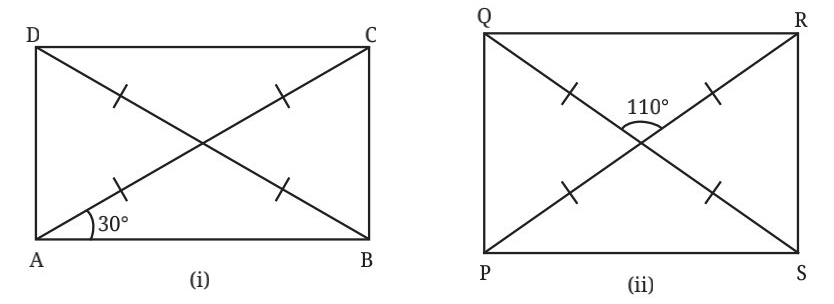
  1. Find all the other angles inside the followling rectangles.

    (i) First Figure

    Given: Angle at A = 30°

    This is the angle between the bottom side (AB) and the diagonal.

    Step 1: Find angle between diagonals

    Since each diagonal makes the same angle with the base:

    Angle between diagonals=2×30°=60°

    Step 2: Use vertically opposite angles

    At the intersection:

    • One angle = 60°
    • Opposite angle = 60°
    • Remaining two angles = 180° − 60° = 120°

    Step 3: Final answer (i)

    • Small angles = 60°
    • Big angles = 120°

    (ii) Second Figure

    Given: Angle between diagonals = 110°

    Step 1: Find angle each diagonal makes with base

    Angle with base=110°​÷ 2 =55°

    Step 2: Find other angles at intersection

    • Opposite angle = 110°
    • Remaining angles = 180° − 110° = 70°

    Step 3: Final answer (ii)

    • Angles with base = 55°
    • Opposite angles = 110°
    • Other angles = 70°
  2. Draw a quadrilateral whose diagonals are equal in length (8 cm each), bisect each other, and intersect at an angle of:

    (i) 30° (ii) 40° (iii) 90° (iv) 140°

    Step-by-Step Construction (Example: 90° case)

    1. Draw a line segment AC = 8 cm
    2. Mark its midpoint O so that AO = OC = 4 cm
    3. At point O, draw a line perpendicular to AC (i.e., 90°)
    4. On this perpendicular line, mark points B and D such that:
      • OB = OD = 4 cm
    5. Join A → B → C → D → A

    ✔️ You get the required quadrilateral

    For Other Angles

    Repeat the same steps, but in step 3, draw the angle as:

    • 30° → for (i)
    • 40° → for (ii)
    • 140° → for (iv)

Question :3

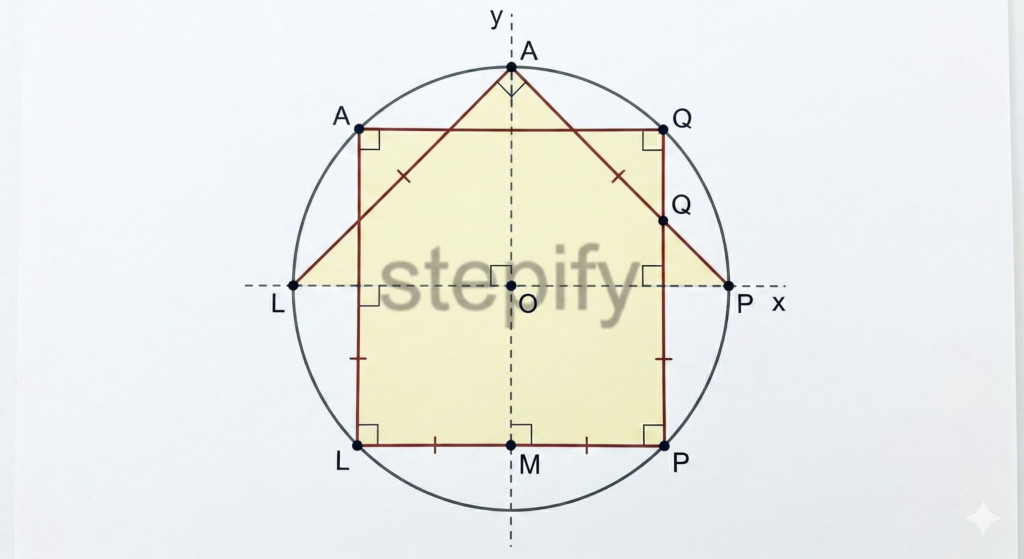
Consider a circle with centre O. Line segments PL and AM are two perpendicular diameters of the circle.
What is the figure APML? Reason and/or experiment to figure this out.

Solution

Step 1: Since PL and AM are diameters, they pass through the centre O.

Step 2: The diameters are perpendicular, so they intersect at an angle of 90°.

Step 3: Points P and L are opposite ends of one diameter, and A and M are opposite ends of the other diameter.

Step 4: Join the points A, P, M, and L to form quadrilateral APML.

Step 5:

  • All four sides are equal because they are chords subtending equal angles at the centre.
  • Each interior angle is 90° due to the perpendicular diameters.

Conclusion: The quadrilateral APML has all sides equal and all angles equal to 90°.

APML is a Square.

Question : 4

We have seen how to get 90° using paper folding. Now, suppose we do not have any paper but two sticks of equal length, and a thread. How do we make an exact 90° using these?

Solution

Idea: Use the property that an angle in a semicircle is 90°.

Steps:

  • Place two equal sticks end-to-end to form a straight line AB (diameter).
  • Attach a thread to points A and B.
  • Stretch the thread to form a semicircle.
  • Pick any point C on the semicircle.
  • Join AC and BC.

Result: ∠ACB = 90°

Reason: The angle in a semicircle is always a right angle.

Diagram:

A B C

Final Answer:

We can construct an exact 90° angle using the property that the angle in a semicircle is always 90°.

Question:5

We saw that one of the properties of a rectangle is that its opposite sides are parallel. Can this be chosen as a definition of a rectangle? In other words, is every quadrilateral that has opposite sides parallel and equal, a rectangle?

Solution

Step 1: A quadrilateral with opposite sides parallel and equal is called a parallelogram.

Step 2: In a parallelogram:

  • Opposite sides are parallel and equal.
  • But angles are not necessarily 90°.

Step 3: A rectangle is a special type of parallelogram where all angles are 90°.

Conclusion: Just having opposite sides parallel and equal is not sufficient to make a rectangle.

Diagram:

A B C D Angle ≠ 90°

Explanation of Diagram: The figure shown is a parallelogram. Opposite sides are equal and parallel, but the angles are not 90°, so it is not a rectangle.

Final Answer:

No, not every quadrilateral with opposite sides parallel and equal is a rectangle. Such a figure is a parallelogram. A rectangle must have all angles equal to 90°.

Home
Account
Cart
Search
Scroll to Top