Number Systems l Exercise 1.2Solutions | Step-by-Step Explanation
Chapter: Number Systems
Class: 9 (CBSE)
Exercise: 1.2
Introduction
Here are the complete step-by-step solutions of NCERT Class 9 Maths Chapter 1 – Number Systems Exercise 1.2.
Each question is explained with proper concepts and reasoning for better understanding.
Important Concepts Used in Exercise 1.2
1. Real Numbers
Real numbers include both rational and irrational numbers.
2. Rational Numbers
Numbers that can be written in the form p/q, where q ≠ 0.
3. Irrational Numbers
Numbers that cannot be written in the form p/q. Their decimal expansion is non-terminating and non-repeating.
Exercise 1.2 Solutions
Question 1
State whether the following statements are true or false. Justify your answers.
(i) Every irrational number is a real number.
Concept: Real numbers consist of both rational and irrational numbers.
Since irrational numbers are part of real numbers,
Answer: True
(ii) Every point on the number line is of the form √m, where m is a natural number.
Numbers like 1/2, 3/4, -2, 0 etc. are present on the number line but are not of the form √m.
Answer: False
Reason: Many numbers on the number line are not square roots of natural numbers.
(iii) Every real number is an irrational number.
Real numbers include both rational and irrational numbers.
Example: 1/2 is a real number but not irrational.
Answer: False
Question 2
Are the square roots of all positive integers irrational? If not, give an example of the square root of a number that is a rational number.
Solution:
Square roots of perfect squares are rational numbers.
Example:
√4 = 2
√9 = 3
√16 = 4
These are rational numbers.
Final Answer: No, the square roots of all positive integers are not irrational.
For example, √4 = 2 which is a rational number.
Question 3
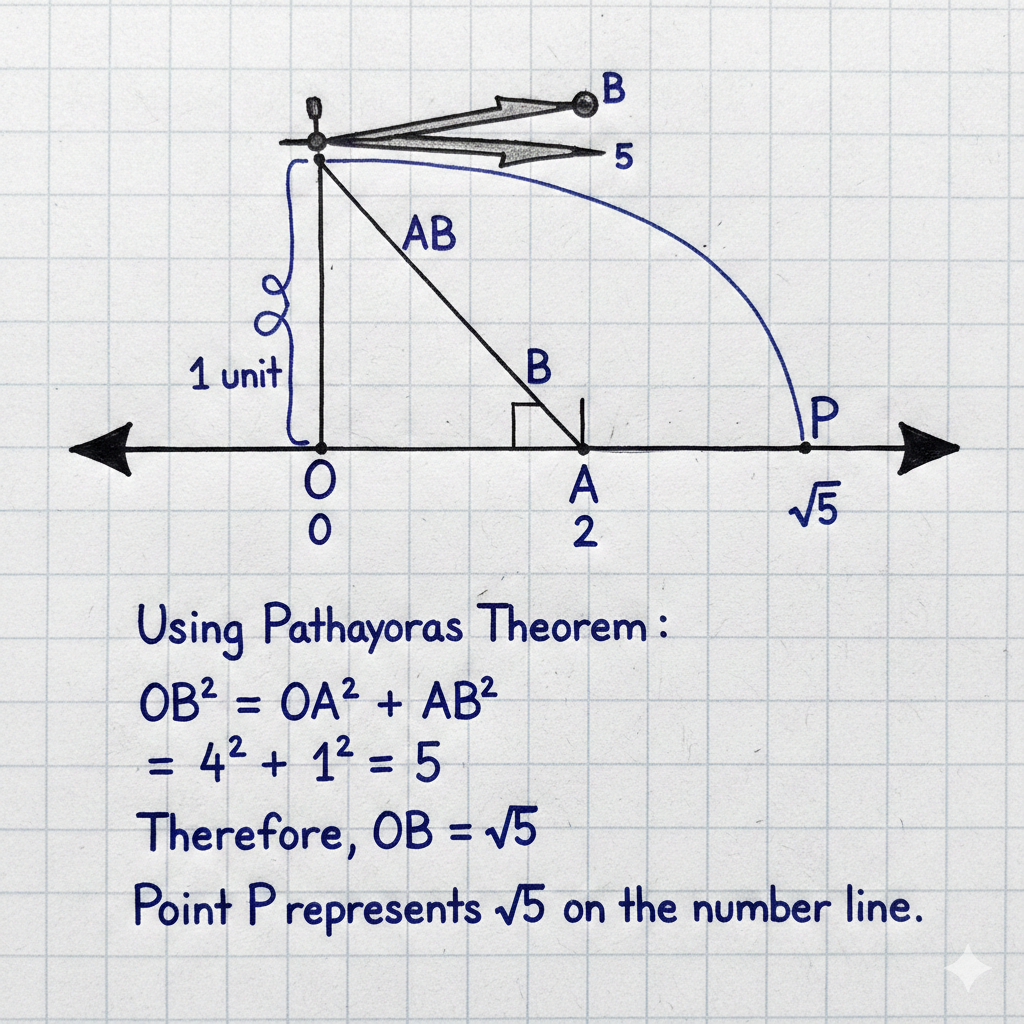
Show how √5 can be represented on the number line.
Construction Steps:
- Draw a number line and mark point O as 0.
- Mark point A at distance 2 units from O.
- At point A, draw a perpendicular AB of length 1 unit.
- Join O to B.
- Using Pythagoras Theorem:
OB² = OA² + AB²
= 2² + 1²
= 4 + 1 = 5
Therefore, OB = √5 - With O as center and OB as radius, cut the number line at point P.
- Point P represents √5 on the number line.
Question 4
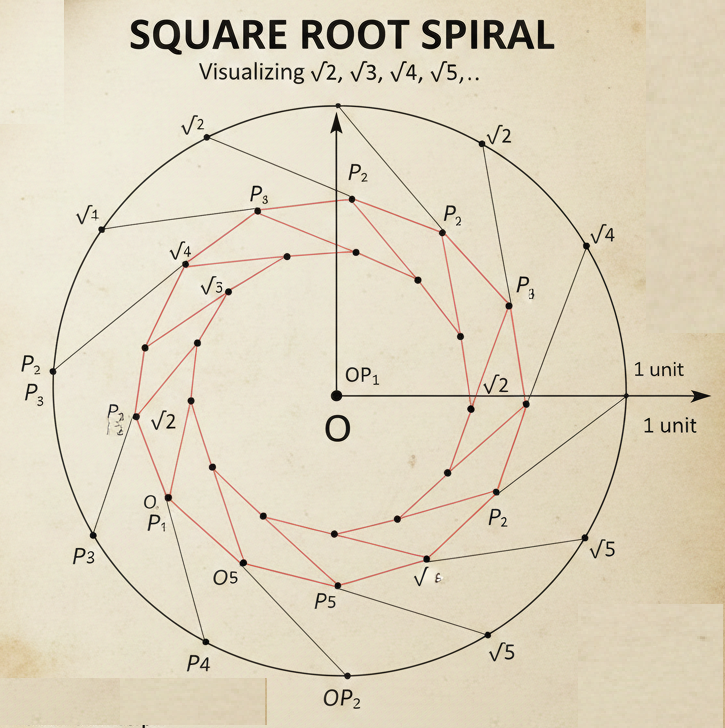
Classroom Activity (Constructing the Square Root Spiral)
Construction Steps:
- Take a large sheet of paper.
- Mark a point O.
- Draw OP₁ of length 1 unit.
- At P₁, draw a perpendicular P₁P₂ of length 1 unit.
- Join O to P₂. This gives √2.
- At P₂, draw a perpendicular P₂P₃ of length 1 unit.
- Join O to P₃. This gives √3.
- Continue this process.
This forms a beautiful spiral known as the Square Root Spiral representing √2, √3, √4, √5 and so on.
Conclusion
- Real numbers include rational and irrational numbers.
- Square roots of perfect squares are rational.
- Irrational numbers can be represented on the number line.
- Square root spiral is constructed using the Pythagoras Theorem.
Visit Stepify.in for complete NCERT Class 9 Maths solutions.